Six buildings, six names, one idea
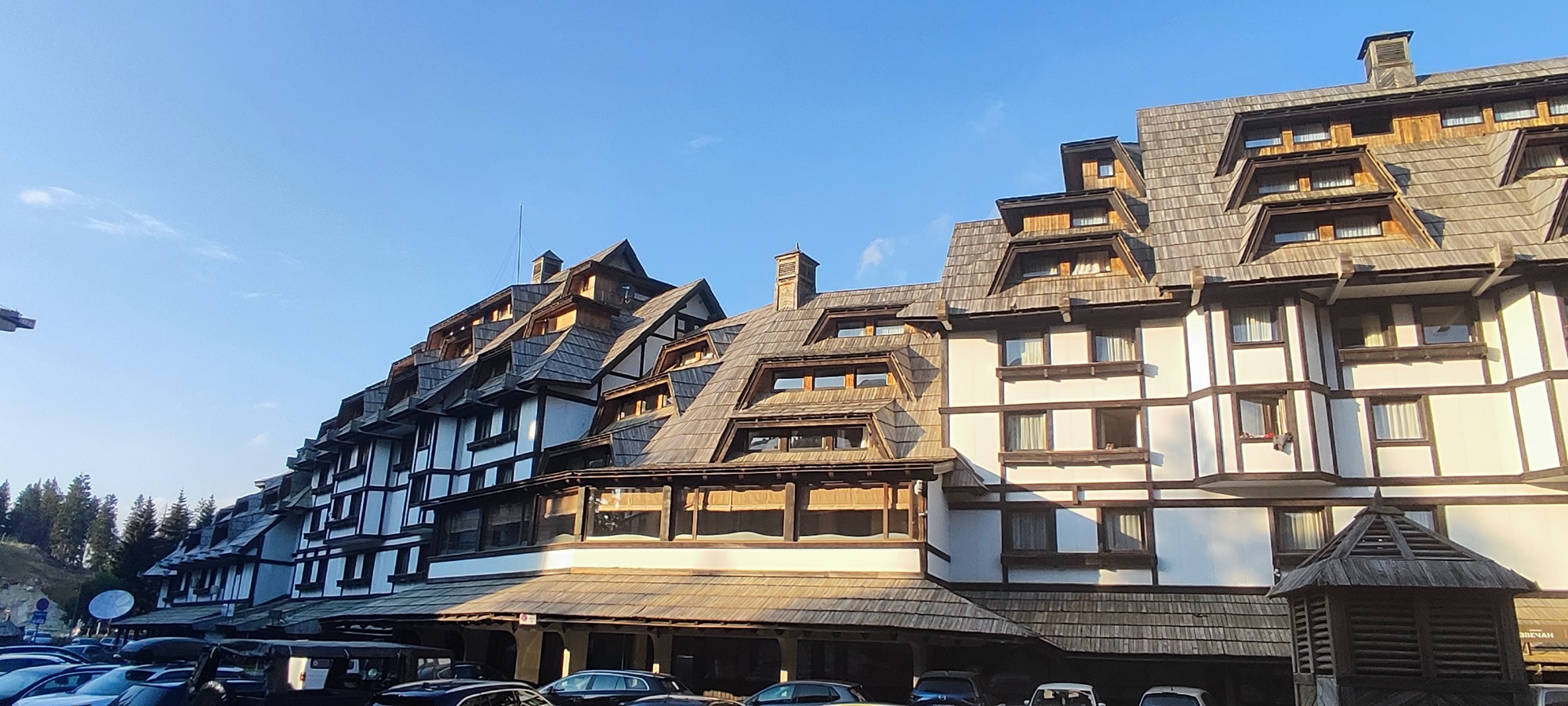
The Konaci complex — better known today as Sunčani vrhovi — was built in the 1980s, when Kopaonik was only beginning to grow into a major ski resort. The developer, Genex, entrusted the work to the architect Kobi Mitrović, widely regarded as the creator of the recognisable "Kopaonik style": low buildings clad in stone and timber that echo mountain villages rather than typical hotel blocks.
Six interconnected buildings, each three to five storeys high, enclose a central square in a semicircle — a layout deliberately modelled on old monastery lodgings, or konaci, which is where the complex takes its name. Instead of numbers or generic labels, each building was named after a medieval Serbian town: Maglič, Ras, Jeleč, Zvečan, Koznik and Brvenik. Konaci 119 is in the Zvečan building.
This was not a random pick of names from a history textbook. All six towns lie in a relatively narrow belt around Kopaonik and the Ibar valley — at the heart of the territory where the medieval Serbian state took shape in the 12th and 13th centuries. For decades Kopaonik was also that state's economic engine: silver and lead were mined here, and fortresses like these six guarded the roads, the mining caravans and the borders around that wealth. The building names are, in other words, a small geographical and historical map of the region the complex stands in.
Zvečan — the fortress that gave the building its name
Zvečan sits on high ground above the confluence of the Sitnica and the Ibar, near Kosovska Mitrovica. The fortress was built on the cone of an extinct volcano at roughly 800 metres above sea level, overlooking the Ibar valley and the approaches from the south, north and west. That position — at the crossroads of the routes towards Kosovo, upstream to Ras and on towards Bosnia — made Zvečan one of the most strategically important strongholds in the region.
The fortress is first mentioned at the end of the 11th century (between 1091 and 1094), during border conflicts between the Serbs and Byzantium over the Kosovo plain, when it was a frontier stronghold of the Raška župan Vukan — according to historical sources, peace talks with the Byzantine emperor Alexios I Komnenos were held here. Zvečan came under permanent Serbian rule in 1170, after the battle of Pantino, and from then on was one of the most significant fortresses of Nemanjić Serbia.
The best-known episode connected with Zvečan took place in 1331: King Stefan Dečanski, after being deposed by his son Stefan Dušan, spent the last months of his life in the Zvečan court. The exact circumstances of his death remain a matter of historical debate — church tradition speaks of a violent death ordered by the court, while reliable historical sources differ on the details. Stefan Dečanski was later canonised by the Serbian Orthodox Church. Later, under Ottoman administration of the Trepča mine, Zvečan continued to serve as a watch fortress over the region's mineral wealth.
Today the Gradina hill above Zvečan holds the remains of ramparts and towers — enough to suggest the scale of the former fortress, though considerably less survives than at, say, Maglič or Ras.
The other five konaci and the towns behind them
Ras — the town that gave the state its name
Stari Ras, about 11 km west of Novi Pazar, was the political and cultural centre of the Serbian state of Raška in the 12th and 13th centuries and the capital of the first Nemanjić rulers. The name of the state itself — Raška — derives from the name of this fortress. Together with the nearby Sopoćani monastery, Stari Ras is today on the UNESCO World Heritage list.
Maglič — guardian of the Ibar gorge
Maglič was built in the 13th century, probably under King Uroš I, to close off the Ibar valley and protect the approaches to Studenica and other endowments after the Mongols burned Žiča in 1241. It is also known locally as "Jerina's town", after a legend about the despotess Jerina Branković, although historical sources do not confirm that she took part in building it. Eight towers linked by ramparts still stand on a rock surrounded by the river on three sides.
Koznik — the fortress on Kopaonik itself
Unlike the others, Koznik stands literally on the slopes of Kopaonik, above the Rasina valley not far from Brus. It is first mentioned in 1381, in a charter of Prince Lazar to the monastery of Saint Athanasius on Mount Athos, and in history it is most often linked to the great chieftain Radič Postupović, a dignitary of Despot Stefan Lazarević. It had eight towers on a square base, including a donjon as the last line of defence.
Brvenik — market and administration on the Ibar
The remains of Brvenik lie eight kilometres north of Raška, above the confluence of the Brvenica river and the Ibar. The exact date of construction is unknown, but during the Middle Ages it was a trading place and the seat of the Brvenik district — an administrative and commercial point, not merely a military stronghold.
Jeleč — the town on Rogozna
Jeleč lies on Mount Rogozna, about 12 km south of Novi Pazar. It entered history in 1282, when King Dragutin injured his leg while hunting near Jeleč — one of the reasons for his abdication in favour of his younger brother Milutin. The town is mentioned again in 1314, and fell under Ottoman rule at the end of the 14th century. Today it is in ruins, with remains of the gate, water cisterns and part of the ramparts.
Why this is more than trivia
When an architect names the six buildings of a tourist settlement after six real medieval towns from the immediate surroundings, that is not decoration — it is a reminder that Kopaonik, long before it became a ski resort, was for centuries the economic and strategic heart of the medieval Serbian state. The mineral wealth of these mountains financed courts, monasteries and armies, and fortresses like Zvečan, Ras, Maglič, Koznik, Brvenik and Jeleč guarded the roads and borders around that wealth. Staying in a building that carries the name Zvečan puts a guest — quite literally, in the address of the accommodation — just one step away from that story.
Frequently asked questions
Can the medieval fortresses in this story actually be visited?
Yes, though not from Kopaonik itself as a short excursion — Ras, Maglič, Brvenik and Jeleč are in the area around Novi Pazar and Raška, while Koznik is near Brus, practically on the mountain. Zvečan is near Kosovska Mitrovica. Each visit needs its own planning of route and time, beyond the scope of this text.
Why is the building housing Konaci 119 called Zvečan?
The name is part of a wider concept from the 1980s — all six buildings were named after medieval Serbian towns from the region, and Konaci 119 is located in the building named Zvečan.
Was Kopaonik really important in the Middle Ages?
It was, above all because of its mineral wealth (silver and lead), which was one of the economic foundations of the medieval Serbian state. The fortresses in the wider area around the mountain, including Koznik on Kopaonik itself, are part of that heritage.
Is all the information about these fortresses firmly established?
Historical sources exist for most of the key dates and events, but certain details — such as the exact circumstances of Stefan Dečanski's death at Zvečan, or who built Maglič — remain a matter of tradition and historical debate, which is noted in the text.
Staying in the Zvečan building
Konaci 119 is a renovated 22 m² apartment in the Zvečan building, in the centre of the Sunčani vrhovi complex on Kopaonik. It sleeps up to three guests and has an equipped kitchen, Wi-Fi, a Smart TV and self check-in.
More about the apartment and booking on the Konaci 119 home page; for an overview of things to do on the mountain, see the Kopaonik guide.